How VOC air-stripping towers work
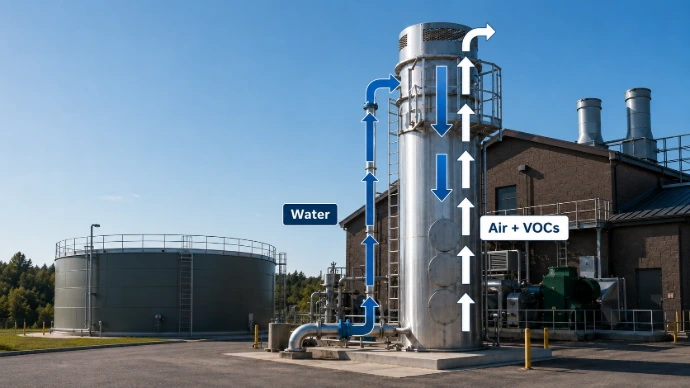
Packed air-stripping towers work by creating high contact between downward-flowing water and upward-flowing air.
Water enters near the top of the tower and passes down through the media / packing, while air from the blower moves upward in a counter-current flow. The packing creates a large surface area and tortuous flow path, allowing Volatile Organic Compounds (VOCs) to transfer from the water into the air stream
Why air-stripping towers lose performance
Over time, that same high-surface-area packing can become fouled. Oxidised minerals — particularly iron and manganese — can precipitate onto the packing surfaces, nozzles, screens, demisters and internal fittings. Biological growth and biofilm can add to this buildup, gradually restricting the open flow paths needed for both water and air movement through the tower.
As fouling accumulates, tower performance can deteriorate in several ways. Water distribution becomes less even, airflow becomes more restricted, blower demand may increase, and the effective contact area between air and water is reduced. The result can be lower VOC-stripping efficiency, increased maintenance frequency, higher operating burden and a greater risk of media blockage or ineffective regeneration.
Pantonite provides a chemistry-led cleaning approach for packed towers and high-surface-area media. Rather than relying only on physical removal or media replacement, Pantonite is used to break down iron, manganese and biological deposits in-situ, helping restore open flow paths through the packing and supporting more reliable air/water contact across the tower.
Media stays in
media and tower internals can be cleaned together without removing media.
Lower cost
Significantly cheaper than media removal for cleaning or replacement
Reduce downtime
Low disruption process minimises operational interruption
How it works
1
Assessment
Assess the tower design, media type, fouling level, access points and treatment objectives.
2
Treatment
Apply Pantonite chemistry through an in-situ circulation and flushing process to contact and clean the fouled packing, trays, fittings and tower surfaces.
3
Flush and Verification
Inspect treated surfaces and media condition, confirm improved cleanliness and return the asset to service with reduced fouling burden and limited downtime.
See a Pantonite clean of a VOC tower in action
In this video - our New England partner, Maher Services, carries out a VOC tower clean on a tower at Acton, MA
Why contractors and utilities choose Pantonite for VOC tower cleaning
Complex media cleaning
Penetrates high-surface-area tower media where iron, manganese and biofilm deposits accumulate across tortuous flow paths.
VOC-stripping support
Helps restore the clean packing surfaces needed for efficient transfer from water droplets into the upward air stream.
Improved flow paths
Breaks down mineral and biological deposits that restrict water distribution, airflow and counter-current contact.
Avoid media replacement
Provides a chemistry-led cleaning option before media removal, replacement or major tower intervention is required.
Results you can see
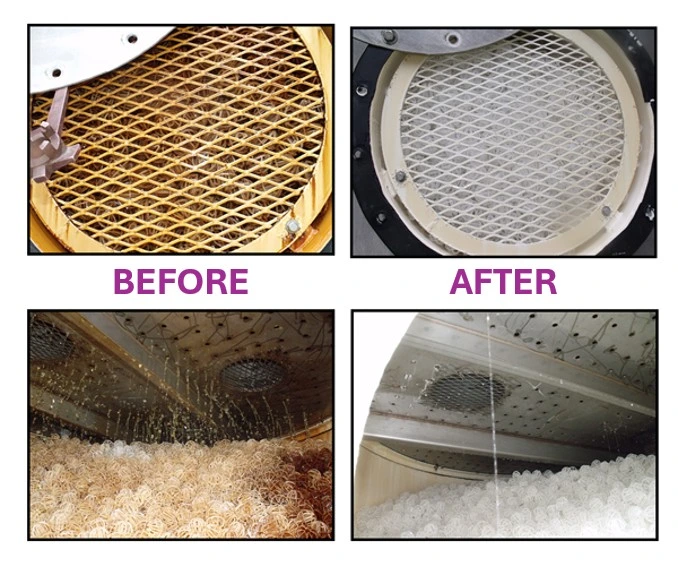
VOC air-stripping tower media before and after Pantonite treatment.
Tri-Pack media shown through a removable inspection hatch and inside the top of the tower during the cleaning process.
See the evidence for yourself
In a bench-top study using fouled Tri-Pack media from the Acton, MA Water District VOC removal aeration tower, Pantonite was tested against alternative cleaning solutions to assess visual removal of iron, manganese and biofilm deposits from high-surface-area tower media.
Over a two-hour test period, the treated media showed clear visual improvement after agitation, rinsing and drying — demonstrating Pantonite’s ability to break down the fouling that can restrict airflow, reduce water contact and compromise VOC-stripping efficiency in packed towers.
View case studies →